

Cataract Surgery
Cataract surgery is the most widely performed surgical procedure worldwide. It involves removing the natural lens from the eye when it has gone cloudy (cataract) and replacing it with an artificial intraocular lens (IOL) to restore clear vision. It is an extremely successful operation that is very tolerable under local anaesthetic. There is a 99% chance of improving the vision, and most people’s eyes will settle down nicely after 4 weeks.

Symptoms of Cataract
- Blurred, hazy, or double vision.
- Glare, halos, or difficulty seeing in bright light or at night.
- Impaired daily activities due to poor vision (e.g., reading, driving).
Benefits of Surgery
- 99% success rate in improving vision.
- Cataract surgery provides an opportunity to simultaneously correct the vision, reducing the need to wear contact lens or glasses.
During your Consultation:
One of our nursing team will test your vision and take several measurement photos of your eyes. It is important to leave soft contact lenses out for 1 week, and rigid contact lenses out for 2 weeks to achieve the most accurate results. Often it is necessary to scan the retina with an OCT scan and the cornea with a Pentacam. Your eyes will then be dilated with eye drops, that sting a little on instillation. They blur the vision for a few hours, but allow for a thorough assessment of the back of the eye. For this reason, it is better not to drive to your first appointment.
Mr Leadbetter will then call you through to the consulting room. Each person’s eyes and vision requirements are different. Mr Leadbetter will make a detailed assessment and talk through potential options and recommendations for achieving the best result with cataract surgery. The next appointment will be for the operation itself.
Procedure
Pre-operatively:
The nursing staff will dilate your eye by placing a tiny little tablet underneath your lower eyelid. This is the best way of dilating you pupil nicely for the operation. You will also be offered a relaxing medication (Diazepam) to help relieve any natural anxiety. Mr Leadbetter will come to see you and answer any questions you might have on the day.
In the operating theatre:
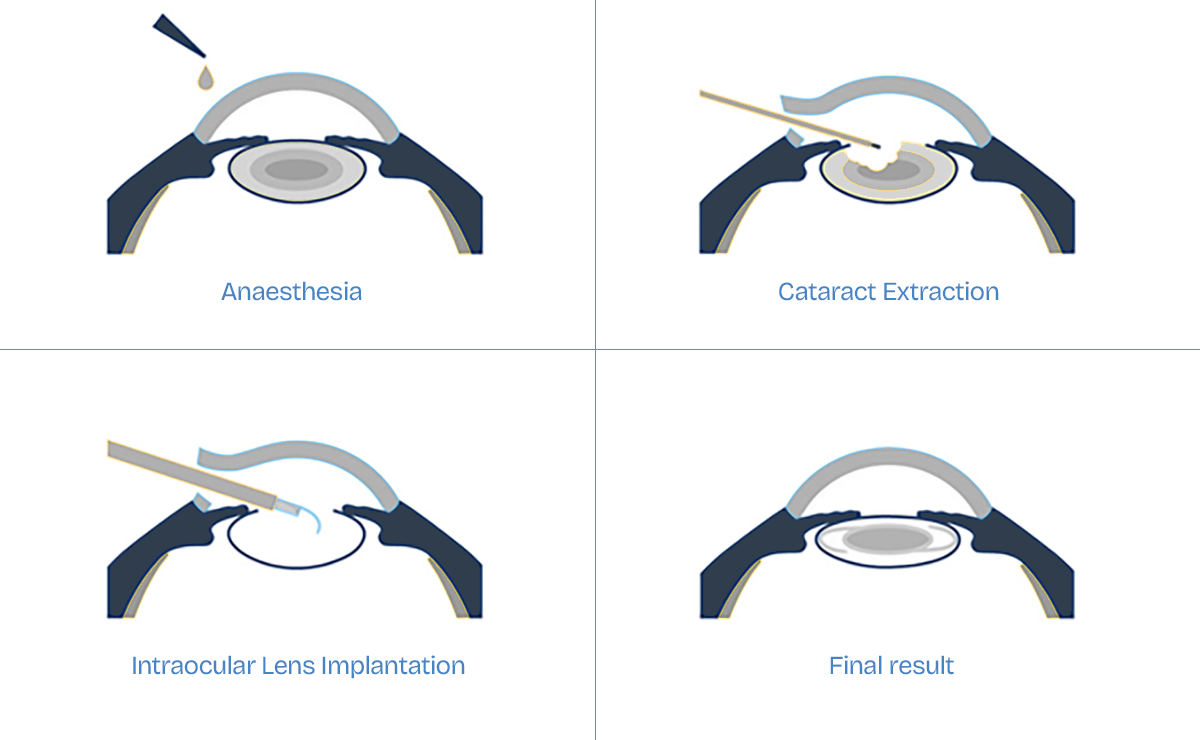
Anaesthetic: Mr Leadbetter performs the vast majority of cataract surgery with topical and intracameral anaesthetic. This involves numbing drops, and more numbing medicine into the front chamber of the eye at the very beginning of the surgery. This avoids an injection, and the eye settles very quickly following this type of anaesthetic. You will not feel anything sharp or uncomfortable, though you will still be able to feel pressure and cold.
It is possible to be put to sleep for the operation with a general anaesthetic, though this is rarely necessary.
Procedure: You will generally be in the operating theatre for around 30 minutes. We perform various safety checks before proceeding with the surgery. You will be laid down on a highly adjustable bed, and we will ensure you are completely comfortable before starting. If having topical anaesthetic, you will need to look up into the bright light of the operating microscope. Though very bright at first, you will get used to this quickly. You will not see instruments coming in and out of the eye.
A microincision is made, the cloudy lens is broken up with ultrasound and removed, and an IOL is implanted. The procedure normally takes 10-15 minutes per eye. Normally, one eye will be done first, with the second eye at a later date.
Recovery:
Patients go home the same day. Vision often improves within days, with full recovery in around 4 weeks. Anti-inflammatory drops are used for 4 weeks.
Risks of Cataract Surgery:
- 1 in 1000 chance of a permanent, serious loss of vision.
- 1 in 30 chance of a more minor problem that would require further treatment. This is more commonly extended drop treatment, though other operations are more rarely required.
- 1 in 100 risk of damaging the lens capsule, which lengthens the operation and post operative course.
- 1 in 4 chance of clouding of the lens capsule after the operation (posterior capsule opacification) that can be treated with a quick, painless and safe laser treatment.
Post-Procedure Care:
- Wear an eye shield for the first few hours after surgery, and overnight for 1 week.
- Avoid rubbing the eye, heavy lifting, or strenuous activity for 1–2 weeks.
- All activities can resume after 4 weeks.
- Follow-up check at 1-4 weeks after surgery.
- New glasses may be prescribed after 4 weeks if needed.
Discussion with Duncan is important to answer any questions that you may have. For information about any additional conditions not featured within the site, please contact us for more information.