
Intraocular Lens Options
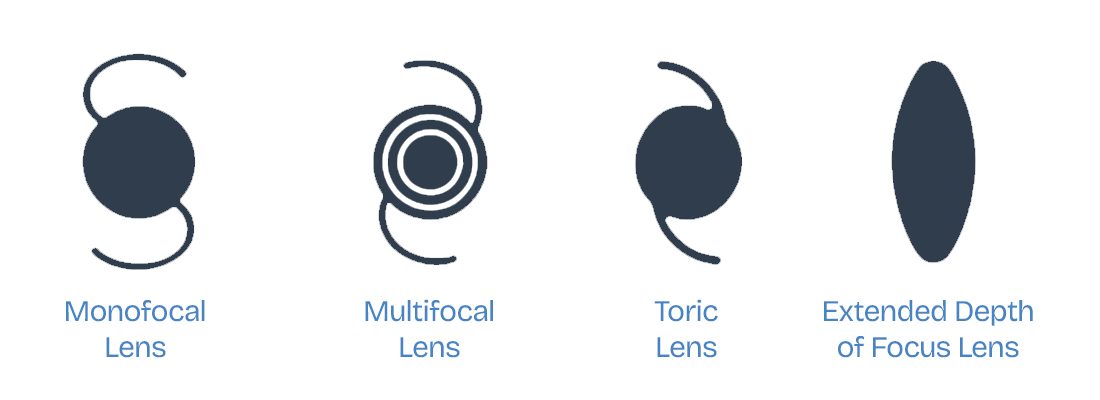
Intraocular lens (IOL) options range from basic Monofocal lenses to advanced Premium Lenses, including Toric lens for astigmatism, EDOF (Extended Depth of Focus) for intermediate distance, and Trifocal/Multifocal for all distances. For more information on each option, jump to the relevant section below:
Monofocal Lens
Monofocal intraocular lenses (IOLs) are artificial lenses implanted during cataract surgery or refractive lens exchange (RLE) to replace the eye’s natural lens, correcting vision at a single focal distance (typically distance vision). They are the most common type of IOL used.
Characteristics:
- Design: Fixed focus for one distance (near, intermediate, or far), most often set for clear distance vision (e.g., driving, watching TV).
- Material: Made of biocompatible materials like acrylic or silicone, foldable for insertion through micro incisions.
- Function: Corrects refractive errors like nearsightedness or farsightedness but does not address astigmatism or presbyopia (unless monovision is targeted).
Indications:
- Patients undergoing cataract surgery or RLE seeking the best quality vision for one distance.
- Suitable for those who don’t mind using glasses for intermediate/near tasks (e.g., using a computer or reading) or have lifestyles prioritising distance vision.
- Preferred for patients with certain eye conditions (e.g., glaucoma or macular degeneration) where extended-depth-of-focus IOLs or multifocal IOLs may reduce contrast sensitivity.
Effectiveness:
- Provides the best clarity and contrast sensitivity of any IOLs (provided there is no significant uncorrected astigmatism).
- Minimal risk of glare/halos compared to multifocal IOLs.
- Patients can opt for monovision (one eye set for distance, one for near) to reduce glasses dependence, though adaptation may be required.
Limitations:
- Does not correct presbyopia, so glasses are typically needed for near or intermediate tasks if set for distance (unless monovision is targeted).
- Patients with significant astigmatism require glasses unless a toric IOLs is used.
Further information: https://www.myalcon.com/ca/cataracts/lenses/
Toric Lens
Toric intraocular lenses (IOLs) are specialised lenses implanted during cataract surgery or refractive lens exchange (RLE) to replace the eye’s natural lens, correcting both refractive errors (nearsightedness or farsightedness) and astigmatism. Unlike standard monofocal IOLs, toric IOLs have a unique design to address corneal astigmatism, reducing the need for glasses or contact lenses.
Characteristics:
- Design: Monofocal lenses with different powers in specific meridians to correct astigmatism. They are precisely aligned with the cornea’s astigmatic axis during surgery.
- Material: Made of biocompatible materials like acrylic or silicone, foldable for insertion through micro incisions.
- Function: Corrects astigmatism (typically ≥1.0 dioptre) and provides clear vision at a single focal distance (usually distance), though toric multifocal or extended-depth-of-focus options exist for broader vision ranges.
Considerations:
- Requires preoperative measurements (e.g., corneal topography) to determine astigmatism degree and axis for precise lens alignment.
- Procedure takes a little longer than cataract surgery with monofocal IOLs, as the eye needs to be marked at the start of surgery, and the IOL needs to be rotated to an exact alignment within the eye.
Indications:
- Patients with cataracts or seeking RLE who have significant corneal astigmatism (≥1.0 dioptre).
- Ideal for those wanting reduced dependence on glasses for distance vision, especially if astigmatism complicates vision correction.
- Suitable for patients ineligible for corneal procedures like LASIK due to thin corneas or other factors.
Effectiveness:
- Corrects astigmatism effectively, with the vast majority of patients achieving excellent distance vision without glasses.
- Studies show 60–70% of patients with toric IOLs achieve ≤0.5 dioptres of residual astigmatism.
- Improves visual clarity and reduces glare/halos caused by uncorrected astigmatism.
Limitations:
- Primarily corrects distance vision (unless a toric multifocal IOL is used), so glasses may be needed for near tasks due to presbyopia.
- Precise alignment is critical; very rarely, lens rotation can occur post-surgery, requiring repositioning.
Risks
- 1 in 100 chance of lens misalignment needing repositioning.
Further information:
Alcon Clareon Vivity EDOF Lens
The Alcon Vivity Lens is a premium intraocular lens (IOL) offering advanced vision correction for patients seeking high-quality vision and greater spectacle independence whilst minimising the risk of visual disturbances such as glare, halos, and starbursts
Key Features and Benefits
- Extended Vision Range: The Vivity IOL is designed to provide excellent distance and intermediate vision (e.g., for computer work or driving) and functional near vision (e.g., reading a smartphone or menu), reducing dependency on glasses compared to monofocal lenses. However, reading glasses may still be needed for fine print or prolonged close-up tasks.
- Toric Option: Available in toric versions, it corrects corneal astigmatism, improving vision clarity for patients with this condition.
- Non-Diffractive Design: The X-WAVE™ technology minimizes visual disturbances such as glare, halos, and starbursts, offering a visual disturbance profile similar to monofocal lenses, making it suitable for night driving and low-light conditions.
- High Patient Satisfaction: Clinical studies and real-world data from over one million implants worldwide show high satisfaction rates, with 94% of patients reporting good or very good distance vision and 92% for intermediate vision without glasses.
Limitations and Considerations
- Near Vision: While functional for near tasks, the Vivity IOL is less effective for near vision compared to trifocal lenses like Alcon’s PanOptix, with 56% of patients achieving 6/12 near vision acuity.
- Low-Light Performance: Some patients may experience reduced contrast sensitivity in dim lighting, which could affect night vision, though less severely than with multifocal lenses.
- Candidate Suitability: Best results are achieved when implanted in both eyes. It is suitable for a broad range of patients, including those with mild comorbidities (e.g., glaucoma, dry eye), but careful preoperative evaluation is needed.
Clinical and Market Impact
In summary, the Alcon Clareon Vivity Lens is a groundbreaking EDOF IOL that enhances vision across multiple distances with fewer side effects than traditional multifocal lenses, improving quality of life for cataract patients. However, patients should discuss with Mr Leadbetter to determine if it suits their vision needs and lifestyle, considering its benefits and limitations.
Further information:
Rayner Rayone Galaxy Lens
The Rayner RayOne Galaxy and Galaxy Toric are innovative intraocular lenses (IOLs) launched in September 2024 at the European Society of Cataract and Refractive Surgeons (ESCRS) Congress in Barcelona, marking the world’s first spiral optic IOLs designed with artificial intelligence (AI). Developed by Rayner, a UK-based ophthalmic surgery manufacturer, in collaboration with Brazilian ophthalmologist João Marcelo Lyra, MD, PhD, these lenses aim to provide premium vision correction for cataract and refractive lens exchange patients, particularly those with presbyopia.
Key Features and Benefits
- Spiral Optic Design: The RayOne Galaxy features a patented non-diffractive spiral optic, created using an AI engine trained on patient outcomes. This design delivers a continuous full range of vision—near, intermediate, and distance—with a smooth transition, reducing the need for glasses. The spiral pattern elongates focus, enhancing depth of field without the distinct focal points of traditional multifocal or trifocal lenses.
- Minimised Dysphotopsia: The lens significantly reduces visual disturbances like halos, glare and starbursts, especially in low-light conditions, with a dysphotopsia profile closer to enhanced monofocal IOLs than diffractive trifocals. Clinical evaluations report 74% of patients experiencing no glare and one-third reporting no halos.
- Zero Light Loss: Unlike diffractive lenses, the non-diffractive spiral optic ensures 0% light loss, maximizing light transmission to the retina for clearer, brighter vision and improved contrast sensitivity.
- Toric Option: The Galaxy Toric version corrects corneal astigmatism, broadening its applicability for patients with this condition.
- High Patient Satisfaction: Early clinical feedback from over 180 eyes across 10 countries shows overwhelmingly positive results, with patients reporting spectacle independence and high-quality vision. A preclinical study indicated comparable visual range to trifocal IOLs but with fewer visual disturbances.
Technical Details
- Zonal Design: The lens likely features three zones: an inner non-spiral refractive zone for distance vision (1.1 mm diameter), a middle spiral optic zone (1.1–3.2 mm) that twists light to create multifocal properties, and an outer zone dedicated to distance vision (beyond 3.2 mm).
- AI-Driven Development: The proprietary AI engine optimized the spiral design based on real-world patient outcomes, enhancing visual acuity and minimizing optical compromises.
Limitations and Considerations
- Near Vision Performance: While the lens provides functional near vision, it may not match the near vision acuity of diffractive trifocal IOLs, potentially requiring reading glasses for fine print or prolonged close-up tasks.
- Adaptation: Some patients may need time to adapt to the spiral optic’s unique light distribution, though early reports suggest seamless adaptation for most.
- Long-Term Data: While initial outcomes are promising, as the IOL is relatively new, it will take time for long-term real-world performance data to be available.
Clinical and Market Impact
In summary, the Rayner RayOne Galaxy Spiral Lens offers a groundbreaking solution for cataract and presbyopia patients, delivering seamless vision across distances with reduced visual disturbances. Patients interested in this lens can discuss this Mr Leadbetter, who will assess their suitability based on lifestyle, ocular health, and vision goals.
Further information:
Alcon Clareon Panoptix
The Alcon PanOptix Trifocal Intraocular Lens (IOL) is a premium lens used in cataract surgery and refractive lens exchange to replace the eye’s natural lens, designed to provide clear vision at near, intermediate, and distance ranges for patients with cataracts or presbyopia.
Key Features and Benefits
- Trifocal Vision: The PanOptix IOL uses a proprietary ENLIGHTEN™ optical technology to distribute light across three focal points: near (40 cm, ~16 inches), intermediate (60 cm, ~24 inches), and distance. This provides seamless vision for tasks like reading, computer work, and driving, significantly reducing or eliminating the need for glasses.
- Toric Option: Available in toric versions, it corrects corneal astigmatism, enhancing visual clarity for astigmatic patients.
- High Spectacle Independence: Clinical studies show 88% of patients never or rarely need glasses post-surgery, with 99% expressing willingness to choose the lens again. Over 80% achieve 20/25 or better vision at all distances without correction.
- Proven Performance: Real-world data from the PanOptix Registry Study and clinical trials (e.g., FDA pivotal study with 243 patients) demonstrate sustained visual acuity, high patient satisfaction, and effective light utilization (88% of light distributed to the retina).
Limitations and Considerations
- Visual Disturbances: The trifocal design can cause visual side effects like halos, glare, and starbursts, particularly in low-light conditions (e.g., night driving). Approximately 15% of patients report bothersome disturbances, though most adapt over time.
- Near Vision Trade-Off: While excellent for near tasks, some patients may need reading glasses for very fine print or prolonged close-up work under dim lighting.
- Contrast Sensitivity: Slight reduction in contrast sensitivity compared to monofocal lenses may affect vision in low-contrast settings, though less impactful than older multifocal designs.
- Patient Suitability: Optimal results require bilateral implantation and healthy eyes. Patients with significant ocular comorbidities (e.g., severe macular degeneration, advanced glaucoma) may not be ideal candidates, necessitating thorough preoperative evaluation.
Clinical and Market Impact
In summary, the Alcon PanOptix Trifocal IOL is a highly effective option for cataract and presbyopia patients, delivering clear vision at near, intermediate, and distance with high satisfaction rates. However, potential visual disturbances and costs should be discussed with a surgeon to ensure it aligns with the patient’s lifestyle and visual needs.
Further information:
Discussion with Duncan is important to answer any questions that you may have. For information about any additional conditions not featured within the site, please contact us for more information.